The 20th century was a period of extraordinary experimentation in visual arts. Photography, once considered a purely mechanical process, began to intersect with painting, challenging traditional ideas of representation, perception, and artistic expression. Artists explored ways to combine photographic realism with painterly techniques, creating works that blurred boundaries between mediums. This fusion not only redefined art but also laid the groundwork for many contemporary practices.
The Rise of Photography as Art
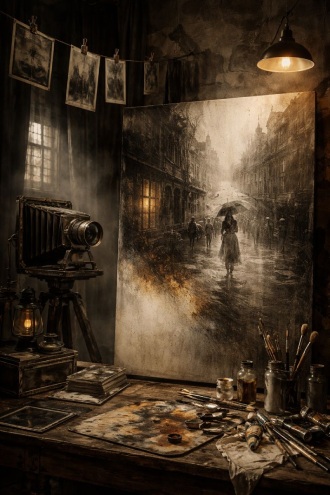
By the early 1900s, photography had evolved from a scientific novelty to a recognized art form. Initially, photographers sought to emulate the compositional techniques and tonal subtleties of painting. This era saw the development of pictorialism, where images were soft-focused, often manipulated in the darkroom, and printed in ways that evoked brushstrokes or layered textures. Photographers treated their prints as objects of aesthetic contemplation rather than mere records of reality.
The desire to align photography with fine art coincided with major shifts in painting. Impressionism, Post-Impressionism, and early Modernism questioned traditional perspectives and color conventions. As photography grew in prominence, painters responded by incorporating photographic principles, such as framing, cropping, and capturing fleeting moments, into their work.
Pictorialism and Painterly Photography
Pictorialist photographers like Alfred Stieglitz and Edward Steichen were central to this movement. They embraced techniques that gave photographs a soft, expressive quality reminiscent of watercolors or oil paintings. By manipulating negatives, using special printing papers, and experimenting with toning processes, they created images that emphasized mood and composition over mere documentation.
This approach influenced painters as well. Some artists began to explore the “photographic eye,” adjusting their compositions to mirror the realism and immediacy of photographs. In doing so, painting and photography became intertwined, each medium borrowing from the other to enrich its visual vocabulary.
The Shift Toward Modernism
By the 1920s and 1930s, both photography and painting underwent dramatic transformations. Modernist painters like Pablo Picasso and Fernand Léger explored abstraction, while photographers like Man Ray and László Moholy-Nagy experimented with photograms, solarization, and montage. This period marked a deeper conceptual blending of media. Photographs were no longer merely reference tools; they became integral to artistic invention.
Artists explored themes of industrialization, urban life, and human psychology, using photography to document reality while painting allowed for emotional and symbolic interpretation. This duality created a rich dialogue between mediums, with each influencing techniques, composition, and subject matter.
Blending Mediums: Techniques and Innovations

The blending of painting and photography was not limited to stylistic inspiration—it extended to direct experimentation with mixed techniques. Artists employed methods that combined both media in a single work, producing hybrid pieces that challenged audiences’ perceptions.
In these experiments, photographs were printed on canvas and painted over, or painters used photographic projections to guide compositions. These methods allowed for the creation of layered, multidimensional works that captured both the immediacy of photography and the interpretive depth of painting.
Photo-Painting Hybrids
One popular practice consisted of combining photographs with elements of painting within the same picture, as examples such as painting a portrait and enhancing or abstracting it hints of paint to introduce texture, color, or symbolism. This practice strived to support the attributes of both media: the precision of the photograph and the expressiveness of painting.
Another technique consisted of projecting photographic slides onto a large canvas, using them as templates for paintings. The artist would have projected the image onto the canvas and gave outlines of the figures, landscapes, or architectural forms on which he might expend his brushwork. This process method would guarantee strong structural underpinnings and allow for expressionistic painting.
Manipulating Photographs for Artistic Expression
Beyond physical hybridization, artists also manipulated photographic prints to achieve painterly effects. Techniques such as retouching, overpainting, or hand-coloring allowed photographers to impart mood, depth, and texture reminiscent of traditional painting.
These manipulations were particularly important for narrative photography, where storytelling demanded more than mere replication. Artists could enhance lighting, adjust forms, or introduce surreal elements, merging the documentary power of photography with the imaginative possibilities of painting.
Gert Berliner and the Intersection of Photography and Painting
Among the artists exploring this intersection was Gert Berliner, a figure whose work exemplified the synthesis of photography and painting. Berliner approached his practice with a focus on both technical precision and emotional resonance, creating pieces that resonated on multiple sensory levels.
His photographs often served as foundational studies, which he would then overlay with paint to emphasize specific forms or moods. The resulting works maintained the realism of the photographic image while adding the interpretive depth of painting. This approach demonstrated that the combination of media could produce something entirely new, rather than simply merging two techniques superficially.
Berliner's Techniques and Style
Gert Berliner’s style was characterized by meticulous attention to composition and subtle painterly interventions. He frequently experimented with tonality, shadow, and color, using paint to highlight certain features or soften others. In some works, he created layered textures, juxtaposing the flatness of photographic prints with the depth of paint.
Berliner’s influence extended beyond his own pieces. He inspired contemporaries to explore interdisciplinary methods, challenging the assumption that photography and painting were mutually exclusive. By embracing both media, Berliner and his peers expanded the possibilities of 20th-century visual art.
Legacy and Influence
The work of Berliner and other hybrid artists paved the way for later developments in contemporary art, including photorealism, mixed-media installations, and digital manipulations. Their experiments showed that crossing disciplinary boundaries could generate innovative aesthetic experiences and new modes of storytelling.
Today, the dialogue between photography and painting continues in experimental and commercial contexts alike. Artists still explore ways to combine technical precision with expressive freedom, a testament to the enduring relevance of 20th-century experimentation.
Key Trends and Movements in the 1900s
The 1900s were marked by several influential movements that bridged painting and photography:
- Pictorialism: Soft-focus, hand-manipulated photographs that emulated painting.
- Modernism: Abstraction and experimentation with form influenced by photographic techniques.
- Surrealism: Blended photographic realism with imaginative, dreamlike elements.
- Photo-Paint Hybrids: Mixed-media works combining photographic prints and painted textures.
These trends reflect artists’ ongoing interest in exploring the limits and possibilities of each medium. They illustrate a century-long curiosity about how reality can be captured, interpreted, and transformed.
Bridging Two Worlds
There was a fusion between painting and photography in the 20th century, which is said to have never occurred before. Artists from pictorialism to modernist experiments and En Ungarhus' transcendence thereof treaded the water of trying to set a balance between the certainty of photography and the freedom of expression in painting. This dialogue allowed for growth in new techniques, forms, and conceptual approaches that continue to influence the visual arts today.